
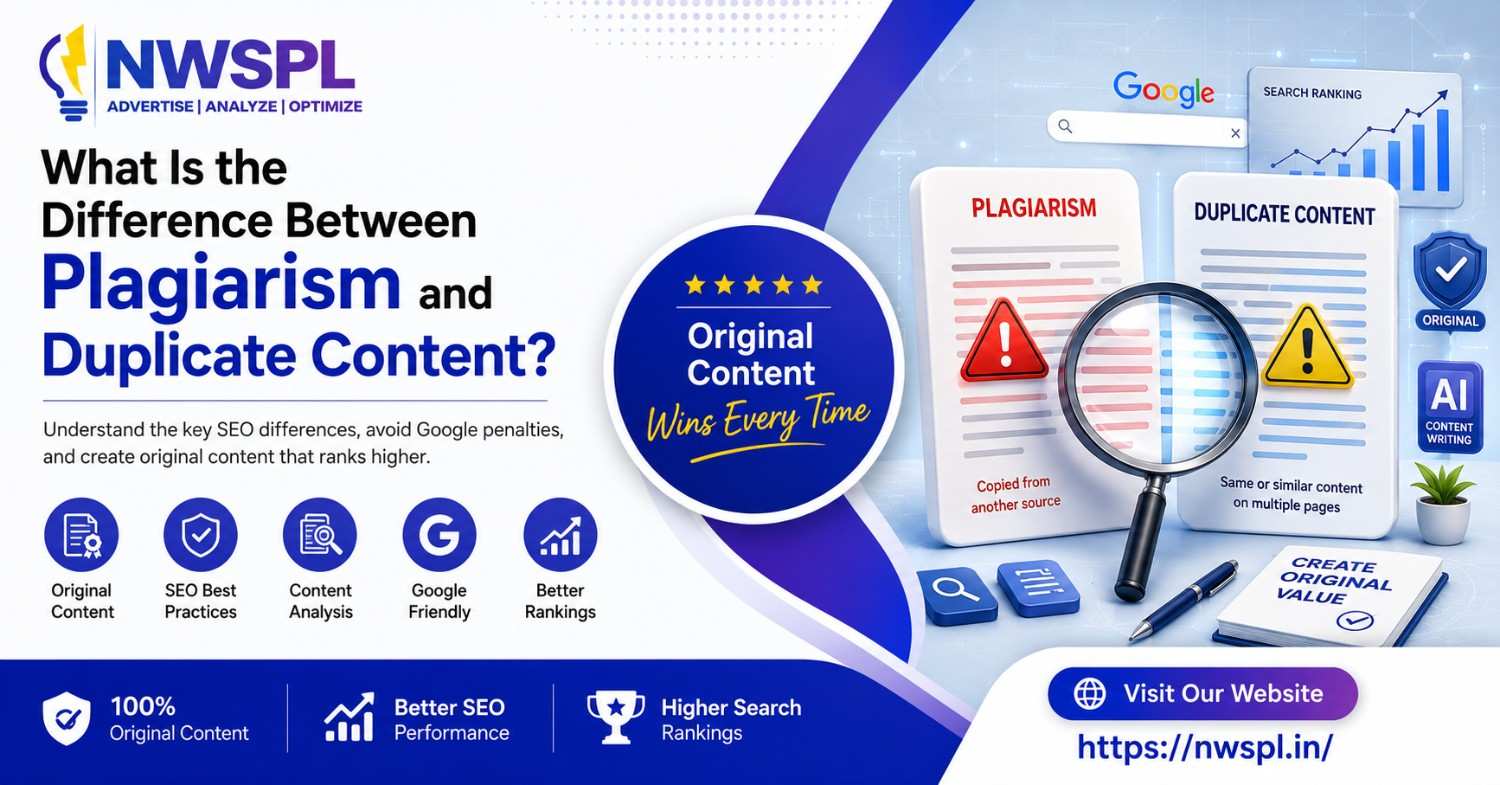
In the world of digital marketing and search engine optimization (SEO), two terms that often cause confusion are plagiarism and duplicate content. While they may seem similar on the surface, they are fundamentally different in their nature, causes, legal standing, and impact on your website. Understanding the distinction is critical for every business, blogger, or content marketer who wants to protect their online presence and maintain strong search engine rankings.
According to Google’s Gary Illyes, approximately 60% of the entire internet is made up of duplicate content. This staggering figure highlights how widespread the issue is, and why every website owner needs to understand and address it strategically.
What Is Plagiarism Content?
Plagiarism is the act of taking someone else’s words, ideas, or creative work and presenting them as your own, without giving proper credit or obtaining permission. In the context of web content, it means copying text, articles, or other written materials from another website and publishing them on your own platform as original. Plagiarism is fundamentally a legal and ethical issue. The original content owner has the right to take legal action if their work is used without authorization.
It can take several forms, Including:
- Direct plagiarism: Copying an entire article or blog post word-for-word and removing the original author’s name.
- Patchwriting: Rewriting another source’s text with minor word changes while maintaining the original sentence structure and ideas without attribution.
- Copy-and-paste fragments: Stitching together sentences or paragraphs from multiple external sources to assemble a single article.
- Self-plagiarism: Reusing substantial portions of your own previously published content without acknowledgment, which over time can also harm your site’s ranking.
It is important to note that plagiarism, on its own, is not always an SEO issue. It becomes an SEO concern specifically when it creates duplicate content on the web, which can then confuse search engine algorithms and lower rankings.
How to Check for Plagiarism Content
Identifying plagiarism on your website or in content submitted by writers requires dedicated tools. Here are the most reliable ways to check:
- Use a plagiarism checker tool: Tools like Copyscape, Grammarly, DupliChecker, and Scribbr scan your content against billions of web pages and flag matched text with a similarity percentage.
- Manual Google search: Copy a unique sentence or phrase from your content and paste it in Google (enclosed in quotation marks) to see if it appears elsewhere online.
- Use the Wayback Machine (Archive.org): If you suspect someone has copied your content, this tool can prove who published the original version first, based on archival timestamps.
- Monitor regularly: Set up Google Alerts for unique phrases from your key articles so you receive a notification whenever that text appears on any new page on the internet.
According to a comprehensive review by Scribbr, free plagiarism checkers detected an average of only 43% of plagiarized content, while Scribbr’s own checker achieved a detection rate of 88%. This shows that for serious content protection, investing in a premium tool provides significantly better results.
How to Fix Plagiarism Content
Once plagiarism is detected, it must be addressed swiftly to protect your SEO standing and legal position. Here is how:
- Rewrite the content completely: Do not just change a few words. Completely rewrite the copied sections in your own voice, adding unique insights relevant to your audience and market.
- Add original value: Google rewards content that is fresh and useful. Ensure any rewritten content contributes something new to the topic rather than recycling existing information.
- Cite and attribute sources: When referencing another source, use proper citations, hyperlinks, and attribution instead of reproducing the text.
- Report theft to Google: If someone has copied your content, you can use Google’s official DMCA removal request form to report the theft and request that the infringing content be deindexed.
- Contact the website owner directly: A polite cease-and-desist request is often the fastest resolution before escalating to formal legal channels.
What Is Duplicate Content?
Duplicate content refers to substantive blocks of content that appear in more than one location on the internet, either within the same website (internal duplication) or across different domains (external duplication). As defined by Google, duplicate content is “substantive blocks of content within or across domains that either completely match other content or are appreciably similar.”
A key difference from plagiarism is that duplicate content does not always involve intent to steal or deceive. It often arises from technical issues and website architecture problems, including:
- HTTP vs. HTTPS versions of a page both being live and indexed.
- URL parameter variations from tracking codes, session IDs, or sorting filters creating multiple URLs for the same content.
- Printer-friendly versions of pages being indexed alongside the regular version.
- Product descriptions copied verbatim from a manufacturer and used across multiple e-commerce pages.
- Syndicated content published on multiple websites simultaneously.
According to former Google engineer Matt Cutts, somewhere between 25% to 30% of all content on the web is duplicative, and much of it is unintentional. Google itself acknowledges that most unintentional duplicate content does not result in a manual penalty, but it can still significantly impact how pages are ranked and crawled.
How to Check for Duplicate Content
Identifying duplicate content across your website requires a combination of crawling and comparison tools:
- Siteliner: A free tool built by the same team behind Copyscape, Siteliner crawls your entire website and identifies pages with duplicate or very similar content. Most sites under 250 pages can be scanned in under five minutes.
- Screaming Frog SEO Spider: A professional-grade website crawler that identifies exact and near-duplicate pages through hash analysis of text and meta elements. The free version supports crawling up to 500 URLs.
- Google Search Console: Use the Coverage report to identify URLs being excluded from Google’s index, which may indicate duplicate content issues.
- Copyscape: While primarily a plagiarism checker, Copyscape can also help identify if your own content is duplicated elsewhere across the web.
- Ahrefs and SEMrush Site Audit: These premium platforms include comprehensive site audit tools that detect near-duplicate content, duplicate metadata, and thin content at scale.
SEO Agency recommend that most sites conduct duplicate content audits on a quarterly basis to catch and resolve issues before they erode search performance.
How to Fix Duplicate Content
The good news is that most technical duplicate content issues can be resolved with well-established SEO fixes:
- 301 Redirect: Set up a permanent 301 redirect from the duplicate URL to the preferred, canonical version of the page. This ensures all link equity and ranking signals are consolidated to the correct URL.
- Rel=Canonical Tag: Add a rel=canonical tag to the HTML head of any duplicate page, pointing to the preferred URL. This signals to search engines which version should receive ranking credit without requiring a redirect.
- Self-Referential Canonical Tags: Add canonical tags to your original pages as well. This is particularly useful if scrapers copy your content along with your HTML, as the canonical will still point back to your original page.
- Consistent URL structure: Choose a single internal link format for your entire website (with or without trailing slashes, www or non-www) and apply it consistently across all internal links.
- No-index for low-value pages: For printer-friendly versions, filtered pages, or paginated archives that add no unique value, consider adding a no-index tag so they are excluded from Google’s index entirely.
Key Differences Between Plagiarism and Duplicate Content
Purpose and Intent
The most fundamental difference between plagiarism and duplicate content lies in intent. Plagiarism is always deliberate. It involves the conscious decision to take another person’s intellectual property and misrepresent it as one’s own. Duplicate content, on the other hand, is most commonly unintentional, resulting from website architecture, CMS configurations, or technical oversights rather than a desire to deceive.
Plagiarism is a moral and legal violation. Duplicate content is primarily a technical SEO problem. This distinction matters greatly: plagiarism can expose a business to copyright lawsuits and permanent reputational damage, while duplicate content typically requires a technical fix rather than legal action.
Impact on SEO and Reputation
Both plagiarism and duplicate content can harm your search engine rankings, but through different mechanisms and with different severities:
- Plagiarism can result in Google de-indexing your site entirely after repeated offenses. It also destroys brand credibility. If your audience or competitors discover that your content is copied, the reputational damage can be severe and long-lasting.
- Duplicate content dilutes link equity. When multiple pages contain the same content, external websites linking to that topic split their backlinks across several URLs instead of concentrating them on one authoritative page. This reduces the ranking power of each individual page.
- Duplicate content burns your crawl budget. Google’s bots have a finite amount of resources to crawl each website. When they repeatedly encounter duplicate pages, they may stop crawling, leaving important pages un-indexed.
- Duplicate content confuses search engines. When Google cannot determine which version of a page to rank, it may suppress all versions, reducing organic visibility and traffic across the board.
From a purely SEO standpoint, duplicate content is the more immediate technical threat to rankings. But from a reputational and legal standpoint, plagiarism carries far greater long-term risk.
Examples of Plagiarism vs. Duplicate Content
To make the distinction concrete, here are real-world scenarios that illustrate each issue:
Examples of Plagiarism:
A freelance writer copies a 1,000-word article from a competitor’s blog, makes minor wording changes, and submits it to your website as original work.
A small business owner reads an industry article they admire and reproduces its key sections on their own website without attribution, assuming it will help them rank for related keywords.
A content agency uses automated spinning software to reword another site’s article and publishes multiple versions across different client sites.
Examples of Duplicate Content:
An e-commerce store uses the same product description provided by the manufacturer across 50 product pages, resulting in near-identical content spread across dozens of URLs.
A website is accessible via both http://example.com and https://www.example.com, and both versions are indexed by Google as separate pages with identical content.
A blog generates separate URL versions for each category tag applied to a post, creating five different URLs that all show the same article.
Tools That Recognize Plagiarism and Duplicate Content
Best Plagiarism Checker Tools
The following tools are widely used and trusted for detecting plagiarized content in web writing:
- Copyscape: One of the most established plagiarism checkers on the market, Copyscape scans content against billions of indexed web pages to identify matching text. The premium version charges approximately 3 cents per search for up to 200 words.
- Grammarly: Beyond grammar correction, Grammarly’s plagiarism checker compares submitted text against a vast database of online content and academic sources.
- DupliChecker: A free tool that uses advanced AI algorithms to detect plagiarism and can even identify AI-generated content in submitted text.
- Scribbr: In independent testing, Scribbr’s checker achieved the highest detection accuracy among free tools at 88%, making it particularly reliable for detecting paraphrased or heavily edited plagiarism.
- Plagspotter: Specializes in URL-based scanning, allowing users to submit a web page URL and discover where its content has been duplicated online.
Best Duplicate Content Checker Tools
For technical duplicate content issues within and across websites, the following tools are most effective:
Siteliner: Free for sites under 250 pages, Siteliner crawls an entire domain and provides a color-coded breakdown of duplicate content percentages per page. It was built by the creators of Copyscape and has been available since 2012.
- Screaming Frog SEO Spider: A downloadable crawler that identifies exact and near-duplicate pages, duplicate title tags, and meta descriptions. The free version supports up to 500 URLs; the paid version is unlimited.
- SEMrush Site Audit: Part of the SEMrush suite, this tool excels at identifying structural duplicate content patterns across large enterprise sites.
- Ahrefs Site Audit: Detects near-duplicate content, thin content, and canonicalization issues at scale with detailed reporting and filtering options.
- Google Search Console: A free tool from Google that surfaces pages excluded from the index, which is often a sign of duplicate content being filtered by the search engine.
How to Choose the Right Tool
The right tool depends on what problem you are trying to solve:
If you want to detect whether someone has stolen your content or whether your writers have plagiarized external sources, use Copyscape, Grammarly, or Scribbr.
If you want to audit your own website for internal duplicate pages, use Siteliner or Screaming Frog, both of which offer free tiers adequate for small to medium-sized sites.
If you manage a large enterprise site with thousands of pages and need duplicate content detection integrated into a broader SEO audit workflow, Ahrefs or SEMrush are the strongest options.
Using a combination of tools gives the most complete picture. No single tool detects every form of duplication, and running both a plagiarism checker and a site crawler provides overlapping coverage of the problem.
Best Practices to Avoid Plagiarism and Duplicate Content
Create Original and Valuable Content
The most effective protection against both plagiarism and duplicate content is a genuine commitment to original content creation. Google’s algorithms reward content that it considers useful, authoritative, and distinct. The more original your content is, the more likely it is to meet those criteria.
This means allocating adequate resources to content development rather than relying on shortcuts such as rewording existing articles. Original content does not have to be lengthy to be valuable; it needs to provide real insights, address the specific needs of your target audience, and reflect your brand’s expertise and voice. Small business owners and marketers should resist the temptation to copy content they admire, as that content is not optimized for their specific website, audience, or service area.
Use Proper Citations and References
When your content draws on external research, statistics, or ideas, proper citation is both an ethical obligation and a practical SEO strategy. Citing your sources builds credibility with readers and demonstrates that your content is grounded in real evidence rather than speculation.
When you quote or paraphrase another source, always include a hyperlink to the original. This practice is not only ethically correct but also protects you from plagiarism accusations. Properly attributed content does not violate copyright, while unattributed reproduction of the same material does. Furthermore, linking out to authoritative sources can actually strengthen the topical authority of your own pages in the eyes of search engines.
Perform Regular Content Audits
Content audits are an essential but often overlooked practice for maintaining a healthy website. A regular content audit involves systematically reviewing all pages on your site to identify issues including duplicate content, thin content, outdated information, and pages that may need to be merged or removed.
SEO experts recommend running a duplicate content audit at minimum once per quarter. Use a tool like Siteliner or Screaming Frog to crawl your site, then review the flagged pages and apply the appropriate fixes: 301 redirects for unnecessary URL variations, canonical tags for intentional duplicates, and rewrites for pages that are too similar to one another.
For content theft, use Copyscape or set up automated monitoring through tools like Copysentry, which can alert you whenever new duplicate versions of your content appear on the web. Staying vigilant is the most reliable strategy for protecting your content, your rankings, and your brand.
Conclusion
Plagiarism and duplicate content are related but distinct challenges that can each cause serious harm to your website’s SEO performance, legal standing, and brand reputation. Plagiarism is a deliberate ethical and legal offense that involves presenting another person’s work as your own, while duplicate content is most often a technical SEO issue resulting from how a website is structured and managed.
As Google’s own data confirms, duplicate content is extraordinarily common across the internet. The key is not to panic, but to stay informed and proactive. Regularly audit your website for technical duplication, enforce strict original content standards for all writers and contributors, and use the right combination of tools to monitor both internal duplication and external content theft.
To drive sustainable business growth, We are NWSPL, Digital Marketing agency in Delhi to build a high-performing content strategy. By prioritizing original content, proper attribution, and strict technical hygiene, we position websites to secure top rankings, cultivate audience trust, and command long-term digital authority.
Frequently Asked Questions
Lazy plagiarism is copying content with minimal effort to disguise it, like swapping a few synonyms or rearranging sentence order while keeping the original structure and ideas intact. It’s called “lazy” because the writer doesn’t bother rewriting the actual thought process behind the content. Search engines and plagiarism checkers catch this easily since the underlying pattern, argument flow, and phrasing still closely mirror the source material.
Yes, 2% plagiarism is generally acceptable in most academic and professional settings. This small percentage usually comes from common phrases, citations, or standard terminology that naturally overlaps across sources. Most institutions and publishers consider anything under 10-15% as reasonable, since zero% is nearly impossible when using industry-standard terms. However, always check your specific institution’s or client’s plagiarism threshold before submitting.
It depends on how you use it. Using ChatGPT to generate content and publishing it as entirely your own original work can be considered a form of academic or professional dishonesty, especially in contexts requiring original authorship. However, using it for brainstorming, editing, or research assistance while writing your own final piece isn’t plagiarism. Always check your institution’s or client’s specific AI-use policy first.
This is called “self-plagiarism,” and it happens when you resubmit previously published work as new without disclosure. It’s considered plagiarism because it misrepresents old work as fresh content, which can violate academic integrity rules or client contracts expecting original deliverables. Even though you wrote it, reusing it without permission or citation deceives the reader into thinking it’s new material.
This is called “cryptomnesia,” and it happens when your brain recalls a story unconsciously without you realizing you’ve seen it before. You can’t fully prevent this, but running your work through a plagiarism checker before publishing helps catch accidental overlaps. If a checker flags matches to something you’ve never intentionally read, it’s usually cryptomnesia rather than deliberate copying.
Paraphrasing means rewriting someone’s idea in your own words while giving proper credit to the original source. Plagiarism happens when you present someone else’s words or ideas as your own without attribution. The key difference is citation and originality of expression. Even a well-paraphrased sentence becomes plagiarism if you skip the citation, since the idea still belongs to someone else.

Akhil Kumar
Our content writer and Digital Marketing expert in SEO has over 3 years of experience in content writing and business analysis, delivering insightful, accurate, and experience-driven content to help you make informed decisions.
Digital Marketing Services
This is a service we provide to help our customers grow and manage their businesses effectively.