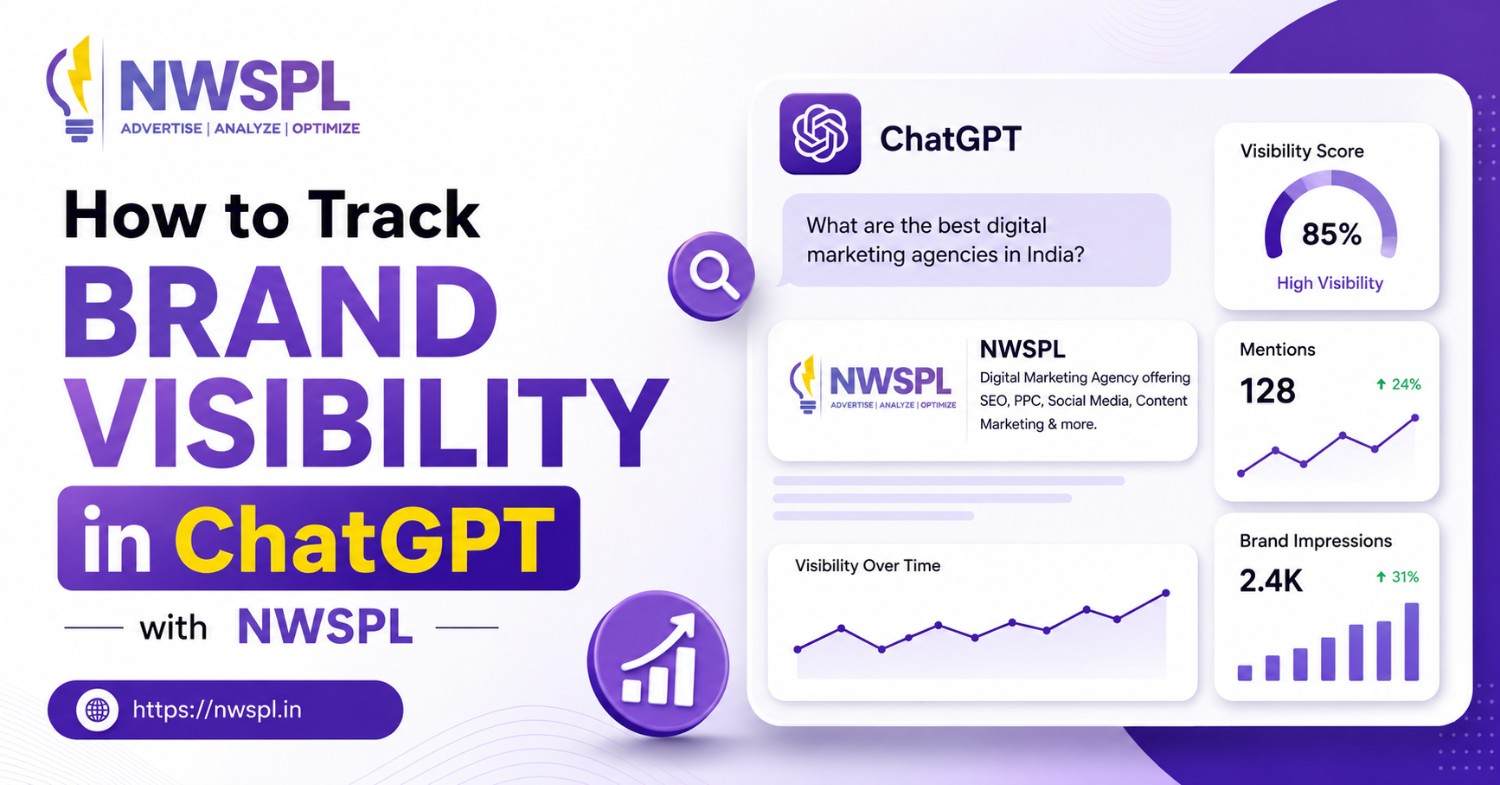
What Does Brand Visibility in ChatGPT Actually Mean?
If you’ve ever typed a question into ChatGPT and noticed it recommending certain brands over others, you’ve already seen brand visibility in action — you just didn’t have a name for it yet.
Unlike Google, ChatGPT doesn’t hand you a results page with ten blue links, ad slots, and a “position 1” you can screenshot. Every answer is generated fresh, shaped by the exact wording of the prompt, the model’s training data, and (increasingly) live web retrieval. That means the old rulebook for measuring visibility, rankings, impressions, click-through rate simply doesn’t translate.
So what replaces it? At NWSPL, we define chatgpt visibility using a handful of concrete, trackable signals:
- Brand mentions in ChatGPT — does the AI name your brand at all, unprompted?
- Source citations — is your website actually linked or referenced as the origin of the information?
- Position within the answer — when several brands show up in one response, who gets mentioned first?
- Citation depth — which specific page on your site is being pulled from?
- Cross-platform consistency — how your presence compares across ChatGPT, Gemini, Claude, and Perplexity.
Put together, these signals give you a real, measurable picture of where you stand. NWSPL turns that picture into a dashboard, so you’re no longer guessing how to check brand mentions in ChatGPT — you’re watching it happen in near real time.
Why Monitoring ChatGPT Brand Visibility Strategies Actually Matters
It’s tempting to file this under “nice to have.” It isn’t. Here’s why.
1. AI Is Quietly Becoming the First Opinion People Form
Before someone visits your website, compares your pricing page, or reads a review, there’s a decent chance they’ve already asked an AI assistant “who’s good at this?” Whoever gets named in that first answer has a head start on trust — and whoever doesn’t is often never considered at all. That’s a huge shift, and it’s happening whether or not brands are watching it.
2. AI Models Behave Like a Trust Filter, Not a Popularity Contest
There’s no public “AI PageRank” score you can check. But in practice, models tend to surface brands that show up repeatedly across sources they consider credible — trade publications, well-structured websites, consistent citations elsewhere on the web. The more consistently your brand appears in that kind of company, the more likely you are to get named again. It compounds.
3. The Competitive Map Has Been Redrawn
A competitor with mediocre organic rankings can still dominate ChatGPT’s answers if their content is easier for the model to cite, or if they’ve built stronger topical authority in a niche. Traditional SEO compares pages. AI-driven search compares brands. Without dedicated monitoring, you won’t notice this shift until a competitor has already pulled ahead.
4. Answers Change — Constantly
Ask the same question twice, days apart, and you may get different brands, different ordering, different citations. Model updates, fresh web content, and even small prompt tweaks all move the needle. A one-time check tells you almost nothing. What you need is monitoring brand mentions in ChatGPT on an ongoing basis, not a single snapshot.
Why Manual Checking Falls Apart Fast
Plenty of teams start by manually typing prompts into ChatGPT and noting down what comes back. It works — for about a week.
- Responses shift even when the prompt doesn’t.
- There’s no built-in history to look back on.
- Rephrasing a query slightly can flip the outcome entirely.
- Comparing yourself against five competitors across dozens of prompts, by hand, isn’t realistic.
- There’s no consistent way to score or rank what you’re seeing.
This is exactly the gap NWSPL was built to close — turning scattered, one-off checks into structured, repeatable tracking.
Introducing the NWSPL AI Visibility Tracking Framework
We’ve built a six-stage framework specifically to answer the question our clients keep asking: how do I track brand visibility in ChatGPT without doing it by hand every single day?
- Prompt & Keyword Intelligence — mapping the real questions your buyers ask
- Multi-Platform Monitoring — ChatGPT, Gemini, Claude, and Perplexity, tracked side by side
- Citation Extraction — pulling and organizing every domain and page referenced
- Rank & Position Detection — turning unstructured answers into comparable data
- Competitor Benchmarking — measuring your share of voice against named rivals
- Trend & Timeline Analysis — watching how visibility moves over weeks and months
Step-by-Step: How to Track Brand Visibility in ChatGPT with NWSPL
Step 1: Build a Prompt Set That Reflects Real Buyer Behaviour
The single biggest mistake brands make is only testing their own name. If you want to genuinely check brand visibility in ChatGPT, you have to test the questions people ask before they know your brand exists.
NWSPL maps and tracks:
- Commercial-intent prompts (“best CRM for small teams”)
- Category and research prompts
- Head-to-head comparisons (“Brand X vs Brand Y”)
- Trust and credibility questions
- High-intent, near-purchase prompts
Examples we’ve tracked for clients: “most reliable digital marketing agency in India,” “top personal loan providers,” “best project management software for startups.” Each prompt is logged and re-run over time, so trends become visible instead of anecdotal.
Step 2: Monitor Across Every Major AI Platform, Not Just ChatGPT
ChatGPT gets most of the attention, but it isn’t the only place people are asking. NWSPL tracks visibility across ChatGPT, Gemini, Claude, Perplexity, and AI Overview results, because each one weighs sources and citations a little differently. A brand that dominates ChatGPT can be nearly invisible on Gemini and you’d never know that without cross-platform monitoring chatgpt brand mentions tools in place.
Step 3: Extract and Map Every Citation
When an AI system references a source, that’s a data point worth capturing. NWSPL’s citation engine:
- Pulls every cited URL from tracked responses
- Groups and cleans up domain-level data
- Flags brand mentions, cited or not
- Tracks which specific pages get referenced, and how often
This is where you start to see, concretely, whether your content is actually being used or whether a competitor’s blog post keeps getting picked instead.
Step 4: Detect Position and Rank Patterns
AI doesn’t hand out a numbered list the way Google does, but order still matters, the first brand mentioned tends to carry more weight than the fifth. NWSPL’s system:
- Records where your brand first appears in each response
- Buckets results into ranges (top 1–4, 5+, or unmentioned)
- Calculates an average position across all tracked prompts
- Flags when that position shifts over time
Step 5: Benchmark Against Your Real Competitors
Visibility only means something in context. NWSPL compares your brand against the competitors that actually show up alongside you — tracking how often each one is mentioned, where they tend to rank, how often they get cited, and where the gaps differ by platform. This is often the moment clients realize a competitor with a smaller ad budget has quietly built stronger AI-search visibility.
Step 6: Track the Timeline
A single report is a snapshot. What actually helps is watching the trend line daily tracking, historical comparisons, and before/after views around PR pushes or content updates, so you can tell whether your efforts to make your brand visible in ChatGPT are actually working.
The Metrics NWSPL Tracks
- Brand Visibility Score — the share of tracked prompts where your brand is mentioned at all
- Citation Count & Cited Pages — how often your domain is cited, and how many distinct pages get referenced
- Average Position — a range-based indicator (e.g., 1–4 or 5+), since AI answers don’t produce a fixed numeric rank
- Rank Distribution — how often you land near the top, lower down, or not at all
- Competitor Share of Voice — your presence relative to named rivals
- Platform Visibility — how performance differs across ChatGPT, Gemini, and Claude
- Top Referenced Pages — which URLs on your site are doing the heavy lifting
- Keyword-Level Performance — which prompts consistently trigger a mention
A Quick Real-World Example
A mid-sized fintech client came to us with a simple problem: they had no idea how often ChatGPT was even mentioning them for “best personal loan providers.” After running our tracking framework for a month, we found their brand appeared in 42% of tracked prompts, sitting at an average position of 3.2 — while one competitor outranked them in 60% of responses. Gemini, interestingly, mentioned the brand more consistently than ChatGPT did.
From there, the fixes were targeted: tightening comparison content, adding clearer FAQ sections, and pushing for more citations in trusted third-party publications. Within a few weeks, position and mention frequency both moved in the right direction — because the team finally had data instead of guesswork.
Building E-E-A-T Signals That AI Models Actually Notice
AI models don’t have a magic “trust button,” but they’re trained to lean on content that demonstrates real Experience, Expertise, Authoritativeness, and Trustworthiness. In practice, that means:
- Experience — first-hand case studies, original data, and specifics that couldn’t be copy-pasted from somewhere else
- Expertise — clear author credentials, cited sources, and technically accurate detail
- Authoritativeness — consistent mentions across respected industry sites, not just your own domain
- Trustworthiness — transparent, up-to-date, well-sourced content that doesn’t overstate claims
NWSPL builds this in deliberately: structured FAQ schema, comparison tables, clear headings, digital PR placements, and consistent entity naming across the web — all things that make it easier for an AI model to both find and trust your brand, We provide SEO Service package so yu can go and check and increase brand value on AI tools.
How NWSPL Helps You Improve, Not Just Monitor
Tracking tells you where you stand. Optimization is how you move the needle:
- Authority building through PR placements and industry publication features
- Citation-ready content — clear structure, direct answers, comparison tables, FAQ schema
- Entity optimization — consistent brand naming and structured metadata so AI models correctly identify you
- Topical depth — content clusters and comprehensive guides that signal real expertise
- Cross-platform alignment — a consistent presence across ChatGPT, Gemini, Claude, and Perplexity
AI Visibility vs. Traditional SEO
Metric | Traditional SEO | AI Visibility |
What’s ranked | Individual pages | Whole brands |
Click dependency | High — traffic is the goal | Moderate — awareness matters more |
Trust signal | Indirect (backlinks) | Direct (source citations) |
Position | Fixed | Dynamic, prompt-dependent |
Comparison | Page vs. page | Brand vs. brand |
AI visibility doesn’t replace SEO — it sits alongside it. The brands that win going forward will be the ones treating both as part of the same strategy.
Why Brands Choose NWSPL for AI Visibility Tracking
- Enterprise-scale monitoring across hundreds of prompts, not a handful of samples
- Multi-LLM dashboards covering ChatGPT, Gemini, Claude, and Perplexity in one place
- Structured citation and rank analytics, so you’re not sifting through raw AI output yourself
- Competitive benchmarking that shows exactly where you stand against named rivals
- Historical tracking so you can prove ROI over time, not just describe it
- A clear optimization roadmap, not just a pile of numbers
The Bigger Picture
AI-driven search isn’t replacing traditional search overnight, but it’s already shaping first impressions before a single click happens. Brands that start monitoring chatgpt brand visibility strategies now rather than waiting until a competitor pulls ahead get to shape the narrative early instead of reacting to it later.
If you’re still wondering how to track brand mentions in ChatGPT, how to see brand mentions in ChatGPT, or simply where to start, Best AI SEO Agency in Delhi. that’s exactly the conversation NWSPL is built to have. Let’s turn your AI visibility from a guessing game into a measurable, improvable part of your growth strategy.
Frequently Asked Questions
Yes — through stronger authority signals, citation-ready content, and consistent entity naming across the web, brands can meaningfully improve how often and how prominently they’re mentioned.
Frequently. Model updates, fresh web content, and even small changes in prompt wording can shift which brands appear and in what order.
It can — citations and mentions build early trust, which often leads users to seek out your site directly, even without a clickable link in the AI response itself.
Related, but not identical. SEO focuses on ranking pages; AI visibility focuses on how consistently and favorably your brand is represented in generated answers. The two strategies overlap heavily but aren’t interchangeable.
Start with a structured prompt set that reflects real buyer questions, then monitor consistently across platforms rather than checking once and moving on — this is exactly where NWSPL’s tracking framework comes in.
ChatGPT remains one of the most widely used conversational AI tools, meaning it often shapes early brand perception before a user ever visits a comparison site or search engine.

Akhil Kumar
Our content writer and Digital Marketing expert in SEO has over 3 years of experience in content writing and business analysis, delivering insightful, accurate, and experience-driven content to help you make informed decisions.
Digital Marketing Services
This is a service we provide to help our customers grow and manage their businesses effectively.